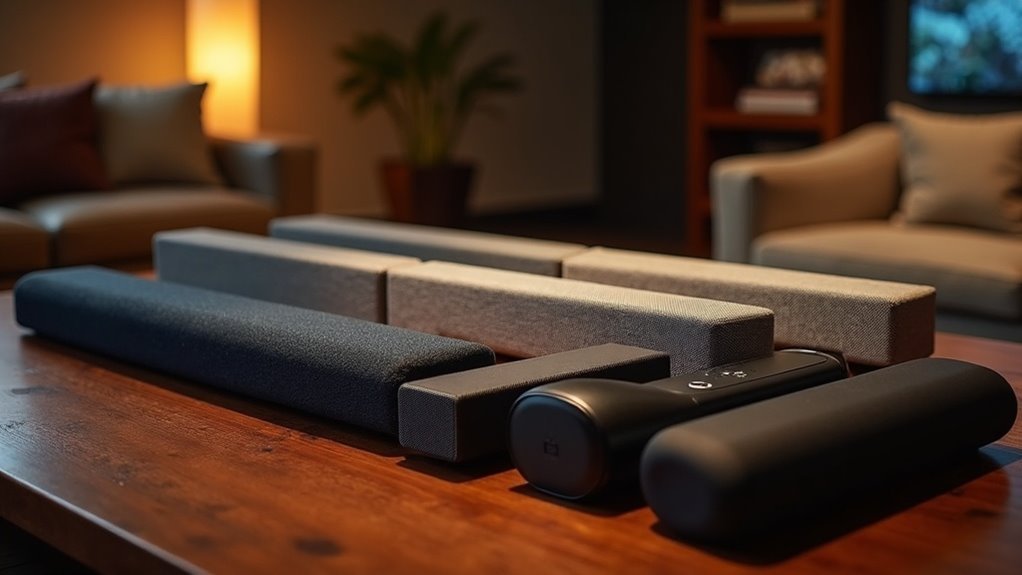
To optimize sound quality in your open-plan space, place your soundbar directly below the TV. This positioning enhances audio projection, ensuring that sound reaches your main seating area effectively. If you’re using an upward-firing model, maintain at least six inches of clearance above it for clear sound dispersion. Experimenting with subwoofer placement, preferably on the same wall as your TV, can further enhance the listening experience. There’s much more to consider for the best soundbar setup in your home.
Key Takeaways
- Position the soundbar directly below the TV to achieve optimal audio projection in an open plan layout.
- Consider wall-mounting the soundbar, ensuring it has at least 6 inches of clearance if using upward-firing models.
- Make sure the soundbar is centered to enhance sound dispersion toward the main seating area.
- Place the subwoofer on the same wall as the TV, and experiment with corner placement to improve bass response.
- Calibrate the soundbar to suit the room’s acoustics, ensuring clear dialogue and an immersive audio experience.
My Room Size and Shape
When you’re considering where to place your soundbar, the size and shape of your room play an important role in achieving ideal audio performance.
In a room approximately 30 feet long and 15 feet wide, strategic speaker placement is essential for immersive sound. The high ceiling can hinder downward-firing models, making upward-firing drivers or wall-bouncing options preferable.
Strategic speaker placement in a spacious room enhances immersive sound, especially with high ceilings.
Solid concrete walls and tiled floors may cause sound reflection, leading to muddiness. Positioning your soundbar centrally below the TV guarantees optimal surround sound projection, enhancing clarity and reducing reverb, especially in larger, open spaces with complex acoustics.
Proper calibration is necessary for superior soundbar performance.
My Surround Sound Preferences
How do you prefer to experience sound in your home entertainment setup with a focus on soundbars? To truly immerse yourself in audio, consider these preferences:
- Virtual Surround Sound: Opt for soundbars equipped with DTS:X or Dolby Atmos to achieve enhanced surround effects without the need for a complex setup.
- Optimal Placement: Ideally, position your soundbar directly below the TV or wall-mount it to enhance aesthetics and minimize visible wiring.
- Subwoofer Inclusion: Incorporating a subwoofer is crucial for elevating your home audio experience by enhancing low frequencies, providing a richer sound, particularly in larger spaces.
These choices ensure an engaging and immersive listening environment that elevates your home entertainment experience through soundbars.
My Ideal Speaker Configuration
Choosing the right soundbar for your home entertainment setup can greatly enhance your audio experience.
Position the soundbar directly on your TV console or wall-mount it below the TV, ensuring it’s centered for the main seating position. This setup allows for ideal sound projection and a clear line of sight.
Remember to maintain at least 6 inches of clearance for upward-firing models. If your seating area is further away, calibrate the soundbar to suit the room’s acoustics, ensuring clarity of dialogue and effective sound dispersion for an immersive experience.
Soundbar Features I Considered
After enhancing your soundbar placement for the best audio experience, it’s time to evaluate the features that will elevate your setup.
Here are three critical features to contemplate:
- Immersive Audio Support: Opt for a soundbar that supports formats like DTS:X or Dolby Atmos for an engaging sound experience that makes you feel part of the action.
- Room Calibration: Consider models equipped with automatic tuning to ensure optimal sound performance tailored to the unique acoustics of your space.
- Clear Dialogue Enhancement: This feature is crucial for a seamless TV-watching experience, especially in open-concept areas where dialogue can easily get lost.
Choosing the right features not only guarantees exceptional sound but also enhances safety and aesthetic appeal in your living environment.
The Best Soundbars for Open-Plan Spaces
When you’re navigating the challenges of sound in open-plan spaces, choosing the right soundbar can significantly elevate your audio experience.
The Sonos Arc Ultra delivers an immersive home theater experience with Trueplay tuning and 9.1.4 Dolby Atmos support, ensuring a rich soundscape.
Experience immersive home theater sound with the Sonos Arc Ultra, featuring Trueplay tuning and 9.1.4 Dolby Atmos support.
If clarity is at the top of your list, the Bose Smart Ultra Soundbar incorporates AdaptIQ technology to minimize echo in larger areas, providing crisp audio.
For those seeking a mid-range option, the LG S40TR features wireless satellite speakers, creating a 4.1 surround sound experience.
And if you’re on a budget, the Samsung HW-C450 offers excellent value with its wireless subwoofer and DTS: Virtual X technology, effectively filling your space with vibrant sound.
Soundbar Placement and Subwoofer Integration
Placing your soundbar correctly can dramatically enhance audio performance, particularly in open-plan spaces where sound can easily dissipate.
Follow these guidelines for ideal soundbar placement and subwoofer integration:
- Center the soundbar directly under the TV to ensure optimal audio projection and a clear line of sight.
- Maintain at least 6 inches of clearance below the TV for wall-mounted soundbars, especially those that utilize Dolby Atmos technology.
- Position the subwoofer on the same wall as the TV, experimenting with corner placement to maximize bass response.
These adjustments can significantly elevate your listening experience in any open area.
Connecting a Soundbar
To get the most out of your soundbar, it’s essential to connect it properly to your TV, ensuring you enjoy high-quality audio with minimal hassle.
Use an HDMI ARC port for connecting your soundbar; this allows for top-notch audio quality with just one cable. If your TV lacks HDMI ARC, an optical cable is a suitable alternative, though it may compromise audio quality.
For optimal audio quality, connect your soundbar via HDMI ARC; an optical cable is a backup if needed.
Don’t forget to enable enhanced HDMI mode on your TV to maximize bandwidth.
With your soundbar connected, you can conveniently control its volume using your TV remote, simplifying your overall user experience.