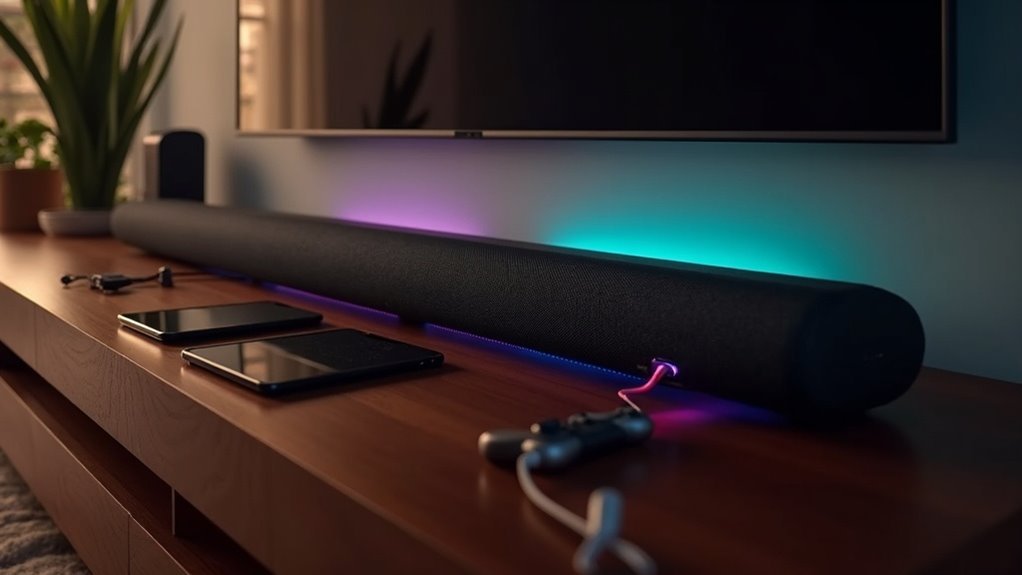
Yes, a soundbar can connect to multiple devices, enhancing your home entertainment experience. By utilizing HDMI inputs, optical cables, or Bluetooth, you can easily switch between devices like gaming consoles, Blu-ray players, and smartphones. HDMI ARC simplifies setup and allows for high-quality audio transmission. Ensuring compatibility with your devices will maximize functionality. If you’re interested in optimizing your soundbar setup further, there are several advanced features and future-proofing strategies to consider. Explore the versatility of soundbars to elevate your audio experience in your home.
Key Takeaways
- Many soundbars feature multiple HDMI inputs, making it easy to connect various devices such as Blu-ray players and gaming consoles.
- HDMI ARC simplifies the setup process, allowing audio to be transmitted from the TV to the soundbar with a single cable, while also enabling control of the soundbar through the TV remote.
- For older devices that may not have HDMI options, optical cables provide a reliable alternative, ensuring compatibility across different technologies.
- Bluetooth connectivity allows soundbars to wirelessly connect to smartphones and tablets, enabling convenient music streaming without the hassle of tangled wires.
- To achieve seamless integration with existing home entertainment systems, it’s crucial to perform comprehensive compatibility checks, including evaluating HDMI and optical inputs.
Understanding Soundbar Connectivity Options
How do you choose the right connection for your soundbar? Start by examining the HDMI inputs available on your soundbar, as these allow you to connect multiple devices like Blu-ray players and gaming consoles directly.
If your soundbar supports HDMI ARC, you can simplify your setup with a single cable connecting your TV and soundbar. When HDMI ports are limited, consider using an optical cable for reliable audio transmission.
Additionally, Bluetooth connectivity offers a wireless option for pairing devices like smartphones. Ultimately, understanding these connectivity options is essential for maximizing your soundbar’s potential while ensuring a safe and efficient audio setup.
Benefits of Connecting Multiple Devices
Connecting multiple devices to your soundbar can significantly elevate your audio experience. With soundbars equipped with multiple HDMI inputs, you can easily connect devices like Blu-ray players, gaming consoles, and streaming devices without the hassle of constantly swapping cables.
This convenience allows for effortless switching between audio sources during your entertainment sessions. By utilizing HDMI ARC, your soundbar can receive high-quality audio from your TV while maintaining video signals from connected devices.
Furthermore, many soundbars offer Bluetooth support, enabling wireless connections to smartphones and tablets for seamless music streaming.
Common Connection Methods
When setting up your soundbar, understanding the common connection methods can greatly enhance your audio experience.
HDMI is a top choice, particularly because it offers multiple inputs for devices like Blu-ray players and gaming consoles. Utilizing HDMI ARC (Audio Return Channel) simplifies connections by allowing audio to flow from your TV to the soundbar using a single cable.
Alternatively, optical cables effectively transmit audio from your TV to the soundbar without requiring direct connections.
Lastly, Bluetooth provides a convenient wireless option, allowing you to stream audio from your smartphones and tablets effortlessly.
Consider these methods for a versatile and effective soundbar setup.
Ensuring Compatibility With Your Devices
To ensure your soundbar integrates perfectly with your devices, begin by verifying its compatibility according to the specifications.
Explore the various connection methods available, such as HDMI, optical, and Bluetooth, to determine the best option for your audio setup.
Additionally, take advantage of HDMI ARC, which streamlines audio management between your TV and soundbar for an enhanced listening experience.
Device Compatibility Check
How can you ensure that your soundbar integrates smoothly with your existing devices? Begin with a comprehensive device compatibility check. Make sure your soundbar has sufficient HDMI inputs for all your audio devices and confirm that it supports HDMI ARC for easy connectivity. Furthermore, verify the presence of optical inputs for older devices. If your soundbar features wireless connectivity, you’ll benefit from the convenience of switching between devices with ease.
| Device Type | Connection Type |
|---|---|
| Blu-ray Player | HDMI |
| Gaming Console | HDMI |
| CD Player | Optical |
| Smartphone | Bluetooth |
Connection Method Options
Several connection methods guarantee your soundbar integrates seamlessly with your devices. You can use an HDMI switch to connect multiple devices like Blu-ray players and gaming consoles directly to the soundbar, enhancing your audio experience.
If you have older equipment, consider an optical audio cable, which ensures compatibility without HDMI support. For a wireless option, Bluetooth allows you to stream audio from smartphones and tablets effortlessly.
HDMI ARC Advantages
While exploring soundbar connectivity options, HDMI ARC (Audio Return Channel) stands out for its ability to streamline audio connections between your TV and soundbar.
This single HDMI cable setup reduces clutter and simplifies your space, making it an ideal choice for soundbar enthusiasts.
With HDMI ARC, you can control both your soundbar and TV using one remote, enhancing convenience and user experience.
It also supports higher quality audio formats like Dolby Digital and DTS, providing a more immersive sound experience compared to standard optical connections.
Most modern soundbars and TVs are equipped with HDMI ARC, ensuring compatibility and easing future upgrades.
Just remember to enable the ARC function in both your soundbar and TV settings for peak performance.
Troubleshooting Connection Issues
To troubleshoot connection issues with your soundbar, start by confirming all devices are powered on and set to the correct input source.
Check these key points:
- Verify compatibility of your devices with the soundbar’s HDMI cable or Bluetooth options to avoid unsupported formats.
- If using HDMI ARC, confirm both the TV and soundbar support it, and ensure the HDMI cable is connected to the correct ARC port.
- For Bluetooth, make sure the soundbar is in pairing mode and your device is within 30 feet to establish a connection easily.
Future-Proofing Your Soundbar Setup
To future-proof your soundbar setup, consider models with multiple HDMI inputs to easily connect various devices.
Look for wireless connectivity options like Bluetooth, which allow you to add new audio sources without the hassle of extra cables.
Additionally, investing in soundbars with the latest technology features, such as 4K HDR pass-through, ensures that you remain compatible with future devices and formats, enhancing your overall audio experience.
HDMI Input Expansion
When upgrading your soundbar setup, considering HDMI input expansion is crucial for ensuring versatility and longevity. A soundbar with multiple HDMI inputs allows you to connect various devices, enhancing your entertainment options.
Here are some important points to consider:
- Multiple Devices: Connect Blu-ray players, gaming consoles, and streaming devices at the same time, providing a seamless entertainment experience.
- HDMI ARC: Simplify your connections and reduce cable clutter by using a soundbar that supports HDMI ARC (Audio Return Channel) for easier integration with your TV.
- HDMI Switch: Utilize an HDMI switch to connect multiple devices to a single input, ensuring you’re prepared for future upgrades.
Selecting a soundbar that also supports Bluetooth and 4K HDR pass-through can significantly enhance your audio-visual experience.
Wireless Connectivity Options
How can you ensure your soundbar setup stays up-to-date as technology advances? Choose soundbars that offer strong wireless connectivity options, such as Bluetooth and Wi-Fi. These technologies enable connections to multiple devices, allowing you to seamlessly switch between smartphones, tablets, and TVs with ease. This not only reduces cable clutter but also enhances your overall audio experience. Furthermore, soundbars that are compatible with smart home systems provide added convenience for controlling your setup throughout your home. When selecting your soundbar, keep the following features in mind:
| Feature | Benefit | Considerations |
|---|---|---|
| Bluetooth | Connect multiple devices | Range limitations |
| Wi-Fi | Smart home integration | Network reliability |
| HDMI Inputs | Expandability | Compatibility checks |
Future-Proof Technology Features
As technology evolves, keeping your soundbar setup relevant requires a keen eye on future-proof features.
To enhance your audio experience, consider the following:
- HDMI ARC: This feature simplifies connections, allowing you to control your soundbar with your TV remote while delivering high-quality surround sound for an immersive viewing experience.
- Bluetooth Connectivity: Opt for soundbars that support multi-device pairing, enabling seamless connections to smartphones and tablets without the hassle of wires, making it easy to enjoy your favorite music and podcasts.
- Advanced Compatibility: Look for support for 4K HDR pass-through and voice assistants to ensure your soundbar adapts to emerging technologies and integrates with external speakers effectively, keeping your audio setup future-ready.