A soundbar doesn’t necessarily need rear speakers, as it can deliver impressive audio on its own, utilizing advanced processing for clarity and depth. However, adding rear speakers can enhance immersion and provide directional sound cues, improving the overall experience. In smaller rooms, rear speakers might muddle the sound, making placement crucial. Evaluating your specific needs and preferences will help you determine if rear speakers are right for your soundbar setup. More insights on this topic await you.
Key Takeaways
- Soundbars can deliver an immersive audio experience on their own, utilizing advanced processing technologies without the requirement for rear speakers.
- Incorporating rear speakers can enhance multichannel audio quality, providing improved directional sound cues for a richer auditory experience.
- In smaller rooms, the addition of rear speakers may result in sound muddiness, which can restrict their effectiveness and create challenges for optimal placement.
- Soundbars are specifically designed for compact spaces, making them an ideal choice for users who value convenience over the complexities of a full surround sound system.
- Ultimately, personal audio preferences and the acoustics of the room play a significant role in determining whether rear speakers are necessary or advantageous for a soundbar setup.
Understanding Soundbars and Their Capabilities
As you explore the world of soundbars, understanding their capabilities is essential for enhancing your audio experience.
Soundbars function as an effective sound system that simulates surround sound through advanced audio processing. Models like the Samsung Q900A utilize Dolby Atmos and DTS:X technologies to create immersive, three-dimensional audio experiences.
Soundbars effectively simulate surround sound using advanced audio processing, offering immersive experiences with technologies like Dolby Atmos and DTS:X.
Many soundbars come equipped with built-in or external subwoofers, which provide deep bass that’s vital for engaging sound, particularly in smaller spaces.
While soundbars can fill a room with sound, they may not offer the same precise directionality and spatial effects as dedicated surround speakers.
Their compact design makes soundbars a practical choice for situations where traditional audio setups are impractical due to limited space.
The Role of Rear Speakers in Home Audio
While soundbars offer a convenient audio solution, they’re designed to deliver a compelling audio experience on their own.
Soundbars are engineered to provide a wide soundstage and simulate surround sound, making them an excellent choice for many users. With their sleek design, they can fit seamlessly into any home entertainment setup, offering an easy installation process without the need for additional speakers.
Many soundbars also come equipped with advanced audio technologies that enhance clarity and depth, allowing for an engaging listening experience for movies, music, and games.
While some may consider adding rear speakers for an even more immersive experience, soundbars alone can provide satisfying sound quality that meets the needs of most users.
Assessing Room Size and Acoustic Limitations
When evaluating room size and acoustic limitations, understanding the impact of space on sound quality is vital, especially when considering soundbars.
In a 9′ x 9′ room, adding rear speakers can lead to muddiness in sound, making a soundbar a more practical and effective choice. Proper placement is crucial, but the close proximity to the rear wall complicates positioning for traditional speakers.
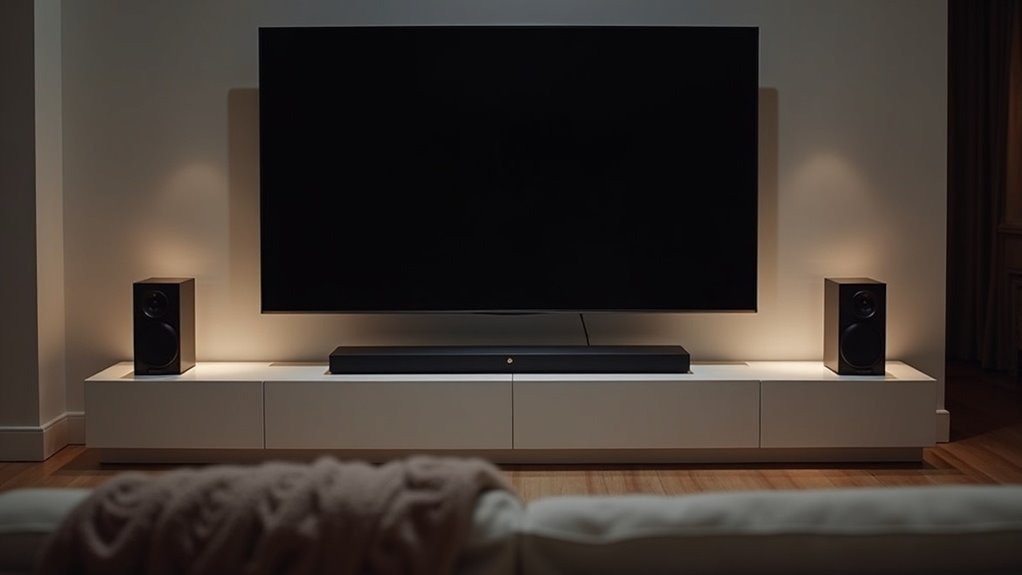
Dolby recommends positioning rear speakers at a 110 to 120-degree angle from your main listening position, which can be challenging in confined spaces. These acoustic limitations often hinder the performance of rear speakers and prevent an ideal soundstage.
In contrast, a soundbar can deliver satisfactory audio without the complexities associated with integrating rear speakers, making it an excellent solution for smaller rooms.
Pros and Cons of Adding Rear Speakers
Adding rear speakers to your soundbar setup can significantly enhance your audio experience, providing directional sound cues that create a more immersive environment.
However, in smaller rooms, the limited space might lead to muddiness in the sound, diminishing the overall quality.
You’ll need to weigh the benefits of a richer soundstage against potential audio quality trade-offs before deciding whether to incorporate rear speakers into your soundbar system.
Enhanced Immersive Experience
Incorporating rear speakers into a soundbar setup can significantly enhance your audio experience, providing vital directional sound cues that elevate overall immersion. While many users enjoy the convenience of soundbars on their own, others find that adding rear speakers brings added depth and quality, particularly in multichannel formats like Dolby Atmos. However, in smaller spaces, the effectiveness of rear speakers may be limited. For optimal performance, proper placement at angles of 110 to 120 degrees is crucial.
| Pros of Rear Speakers | Cons of Rear Speakers |
|---|---|
| Enhanced immersion | Limited effectiveness in small rooms |
| Directional sound cues | Potential muddiness in sound |
| Improved multichannel audio quality | Requires careful placement |
Space Limitations Considerations
While the allure of enhanced audio immersion often draws users to contemplate rear speakers, space limitations can complicate their integration into a soundbar setup.
In a compact 9′ x 9′ room, adding rear speakers may lead to muddiness in sound, undermining the experience. Proper placement, ideally at a 110 to 120-degree angle, proves challenging when seating is against the back wall.
Additionally, experts warn that the investment in rear speakers might be futile in small spaces, as soundbars typically provide sufficient audio quality on their own.
With advanced auto-tuning features, soundbars further simplify sound optimization, making them a practical choice for limited environments.
Audio Quality Trade-offs
Rear speakers can significantly enhance the audio quality of a soundbar setup, particularly for creating a more immersive experience with multichannel formats like 5.1 and Dolby Atmos.
However, there are some trade-offs to consider:
- In smaller rooms, rear speakers can lead to muddiness due to limited space.
- Proper placement is crucial; ideally, rear speakers should be positioned at a 110 to 120-degree angle to achieve optimal surround sound.
- Satisfaction levels vary among users; some may prefer the straightforward setup of a soundbar alone, while others enjoy the added depth that additional speakers provide.
Ultimately, it’s important to weigh the advantages against the potential drawbacks to determine if rear speakers will enhance your audio experience effectively.
User Experiences and Preferences
When considering your audio setup, personal preferences play an essential role in whether you find a soundbar sufficient for your needs.
Many users report that soundbars offer a streamlined and convenient solution for enhancing their listening experience without the complexity of a full surround sound system.
While some may prefer the immersive quality of rear speakers, others appreciate the simplicity and space-saving design of soundbars.
Your choice might also be influenced by factors like room acoustics and the ease of installation, making soundbars an appealing option for those seeking high-quality audio without the need for extensive speaker placement.
Personal Audio Preferences
How important is the listening environment to your audio experience with soundbars? Personal preferences greatly affect whether you find soundbars essential.
Consider these factors:
- The acoustics of your space can amplify or diminish sound quality.
- Your listening habits might lean towards casual enjoyment or immersive experiences.
- Spousal preferences may dictate system choices, balancing aesthetics and functionality.
Many users report satisfaction with soundbars like the Arc, appreciating their convenience and sound quality.
Ultimately, proper placement and calibration can enhance your audio experience, ensuring you find the soundbar setup that best suits your needs.
Surround Sound Impact
While many users find satisfaction with soundbars alone, the addition of surround speakers can enhance the audio experience even further.
Soundbars provide a compact solution for those seeking improved sound quality, and many models now incorporate advanced technologies to simulate surround sound.
For users who prefer a simpler setup, a soundbar combined with a subwoofer can deliver impressive audio performance without the need for additional speakers.
It’s essential to consider personal preferences when choosing an audio system; while some may enjoy the immersive experience of surround sound, others may find that a high-quality soundbar meets their needs perfectly.
Ultimately, the choice depends on your desire for audio quality and convenience in your home entertainment setup.
Placement Considerations for Surround Speakers
To achieve the best audio experience with a soundbar, consider its placement carefully in relation to your main seating area.
- Position the soundbar at ear level when seated for optimal sound distribution.
- If your couch is against the wall, ensure the soundbar is mounted securely to maintain effectiveness.
- Aim for a distance of 2 to 6 meters between the soundbar and your seating to enhance audio immersion.
Angle the soundbar towards you for an expansive feel, ensuring a safe and effective audio setup without pinpointing sound sources.
Balancing Budget and Audio Quality
When considering audio solutions, especially in the realm of soundbars, balancing budget and audio quality becomes essential.
With a budget of about $1400 CAD, you have the opportunity to invest in a high-quality soundbar setup. While separate high-end systems may be out of reach, a soundbar like the Samsung Q950A, paired with rear speakers, can enhance your audio experience for an additional $300.
Soundbars are particularly space-efficient, making them an excellent choice for smaller rooms.
Ultimately, it’s important to weigh your personal preferences against budget constraints to achieve the best soundbar solution for your needs.