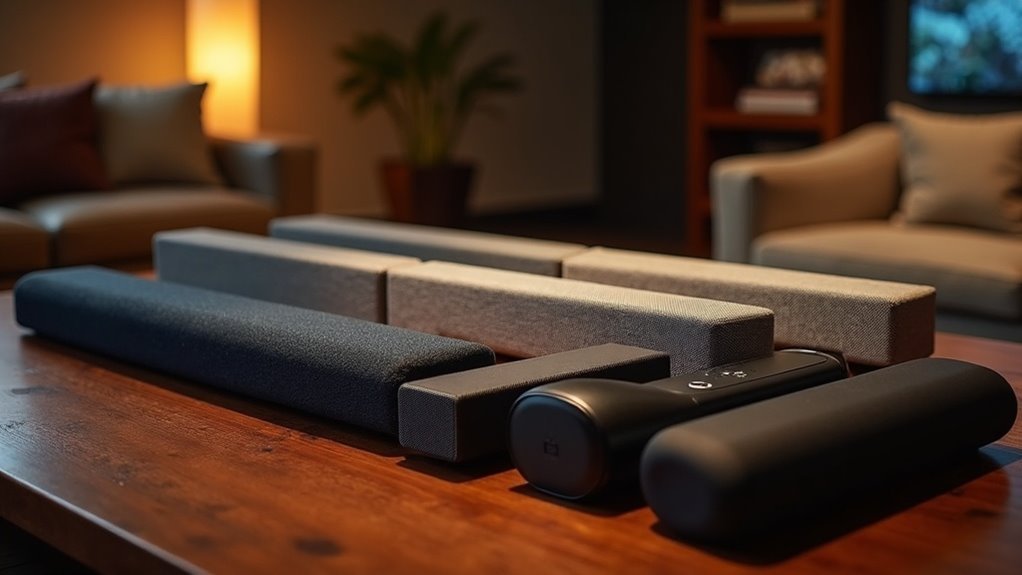
To effectively use a soundbar, start by connecting it to your audio source using the appropriate cables to ensure compatibility. Adjust the soundbar’s volume to achieve a balanced output, preventing distortion for an optimal listening experience. Position the soundbar centrally and at ear level for the best sound projection. Regularly fine-tune the EQ settings to maximize performance. With the right setup, your soundbar can deliver an immersive audio experience, perfect for both casual enjoyment and more serious listening. Explore more tips and tricks for enhancing your soundbar experience next.
Key Takeaways
- Connect the soundbar to your audio source directly to ensure optimal audio quality and minimize latency issues.
- Adjust the volume levels on the soundbar to avoid distortion and maintain balanced sound delivery during playback.
- Regularly calibrate the EQ settings on the soundbar to enhance audio quality and tailor the listening experience to your preferences.
- Position the soundbar strategically for effective sound dispersion and to create an immersive audio environment.
- Use high-quality cables and ensure the setup is free from obstructions to prevent signal degradation and preserve audio integrity.
Understanding the Roles of Soundbars and Studio Monitors
When comparing soundbars, it’s essential to recognize their distinct purposes and design philosophies.
Soundbars are engineered to enhance TV and movie audio, boosting certain frequencies for an immersive experience. They’re designed to provide a more expansive soundstage and improved clarity compared to standard TV speakers.
With their sleek design, soundbars easily integrate into home entertainment setups, offering convenient placement options without compromising aesthetics.
Unlike studio monitors, which prioritize accurate sound reproduction for critical listening, soundbars focus on delivering a captivating audio experience that enhances your favorite films and shows.
Setting Up Your Soundbar and Studio Monitor
To effectively set up your soundbar, begin by establishing the correct connections between your devices. Follow these steps:
- Connect the soundbar to your TV using HDMI ARC or optical cables.
- Adjust your TV’s audio settings to select the correct output for the soundbar, disabling internal speakers if needed.
- Position the soundbar directly above or below the TV for ideal sound dispersion, ensuring that it’s centered for the best audio experience.
Regularly calibrate the audio settings of your soundbar to guarantee a balanced sound experience.
Connecting the Devices to an Audio Source
How can you guarantee a seamless connection between your soundbar and audio source?
Start by ensuring your audio source has multiple output options, like HDMI ARC, optical, RCA, or 3.5mm jacks.
If your soundbar supports RCA inputs, you can use an RCA splitter to send the audio signal to the soundbar.
For digital connections, connect an optical cable directly to your soundbar.
Don’t forget to adjust your audio settings to enable output through the soundbar, selecting the correct audio format.
Be mindful that using multiple outputs may introduce latency issues, especially with Bluetooth-enabled soundbars.
Adjusting Volume Levels for Balanced Sound
Adjusting the volume levels of your soundbar is essential for achieving a balanced audio experience. Follow these steps for ideal sound:
Adjusting your soundbar’s volume is crucial for a balanced audio experience; start with a neutral level and fine-tune as needed.
- Set your soundbar to a neutral level around 0 dB as a baseline.
- Use a sound level meter or audio analysis app to monitor output levels, aiming for consistent dB readings to ensure cohesive audio quality.
- Gradually increase the soundbar volume from a lower level, paying attention to any spikes that could distort sound.
Keep in mind the acoustic environment, and make adjustments as needed based on the type of content you’re enjoying to maintain a balanced audio experience.
Experimenting With Placement for Optimal Audio Quality
Achieving balanced audio with your soundbar isn’t just about volume levels; placement plays a critical role in sound quality. Position your soundbar directly above or below your TV to enhance sound dispersion and create an ideal audio synergy. Testing various distances from walls can help further balance bass response for a fuller sound experience.
| Placement Strategy | Expected Outcome |
|---|---|
| Soundbar near TV | Ideal audio synergy |
| Soundbar elevated or lowered | Enhanced sound dispersion |
| Adjusted distance from walls | Balanced bass response |
Troubleshooting Common Audio Issues
When troubleshooting audio issues with your soundbar, start by identifying any latency problems that may arise between the soundbar and other connected devices.
Next, verify all cable connections are secure and compatible with your soundbar to prevent signal loss.
Finally, adjust your audio settings for optimal performance, ensuring that your soundbar effectively complements your audio sources.
Identifying Audio Latency Problems
To effectively identify audio latency problems between your soundbar and studio monitors, it’s important to understand that this delay often arises from digital signal processing and Bluetooth connections.
Here are three steps to diagnose the issue:
- Play a video with a clear audio-visual cue and observe any desynchronization between the soundbar and studio monitors.
- Test wired connections (RCA or optical) to minimize audio latency and enhance synchronization.
- If your soundbar has audio delay settings, adjust them to help align its audio output with the studio monitors.
Conduct multiple tests with various configurations for accurate troubleshooting in your audio setup.
Ensuring Proper Cable Connections
Audio latency issues often stem from various factors, including cable connections. To ensure optimal performance with soundbars, use compatible cable types like HDMI ARC or optical cables for digital signals to maintain audio quality.
If your soundbar has balanced inputs (like XLR or TRS), make sure you have the necessary adapters for a secure, interference-free connection.
Additionally, verify that the audio output settings on your TV or source device are configured correctly, selecting the appropriate output option.
Keep an eye on volume levels across both the soundbar and any additional connected devices, as mismatched levels can lead to distortion.
Opting for wired connections can further help minimize latency problems.
Adjusting Settings for Compatibility
To ensure your soundbar delivers optimal audio performance, careful adjustment of its settings is essential.
Follow these steps to enhance your sound experience:
- Select the Correct Output: Check the audio output settings on your TV or audio source, selecting the appropriate connection type such as HDMI, optical, or RCA.
- Adjust Volume Levels: Balance the volume on your soundbar to avoid distortion and achieve ideal sound output.
- Calibrate Regularly: Fine-tune EQ settings and positioning of your soundbar to improve audio quality in your listening environment.
Enhancing Your Listening Experience With Additional Equipment
To enhance your listening experience with your soundbar, consider implementing a dual output configuration that allows your soundbar to operate alongside other audio sources, such as studio monitors, if desired.
Focus on audio quality by using high-caliber cables and ensuring ideal room acoustics, as these factors directly affect sound clarity.
Adjusting these elements will help you achieve a more immersive and balanced audio performance with your soundbar setup.
Dual Output Configuration
While setting up a dual output configuration, you’ll enhance your audio experience by connecting both a soundbar and studio monitors.
Here are three key steps to ensure optimal performance:
- Connect your BOSE Soundbar to the TV via HDMI ARC or optical for the best sound quality, while using RCA or a 3.5mm jack for studio monitors.
- Adjust your TV’s audio settings to output sound to both devices, ensuring you select the appropriate output type for the soundbar.
- Position the soundbar above or below the TV for effective sound dispersion, while studio monitors can be used for more detailed audio playback in certain scenarios.
This configuration primarily focuses on maximizing your home audio through the soundbar, providing a balanced and immersive listening experience.
Audio Quality Considerations
Integrating a soundbar into your audio setup can greatly enhance your listening experience, especially for movies and multimedia content. However, it’s essential to consider how soundbars optimize audio.
They’re designed to enhance the cinematic experience, often with a boosted bass and treble response, which may not provide the flat frequency response needed for professional audio tasks like music mixing. This can lead to an imbalance that obscures critical mid-range frequencies, potentially resulting in inaccurate audio representation.
To maintain the best audio quality while using a soundbar, it’s advisable to utilize a dedicated audio interface for dual output, ensuring balanced sound delivery.
Investing in high-quality cables and converters is also crucial to prevent any degradation of audio quality, ensuring that your soundbar performs at its best and integrates seamlessly into your audio setup.
Room Acoustics Impact
While having a high-quality soundbar can significantly elevate your audio experience, the acoustics of your room can still play a crucial role in how sound is perceived.
To optimize your soundbar setup for the best possible performance, consider these important factors:
- Acoustic Treatment: Incorporate foam panels or bass traps in your room to reduce unwanted reflections and enhance the clarity of sound produced by your soundbar.
- Soundbar Placement: Position your soundbar centrally and at ear level for optimal sound dispersion and to create a more immersive listening experience.
- Avoiding Obstacles: Ensure that nothing obstructs the soundbar, as this can interfere with sound projection and overall audio quality.